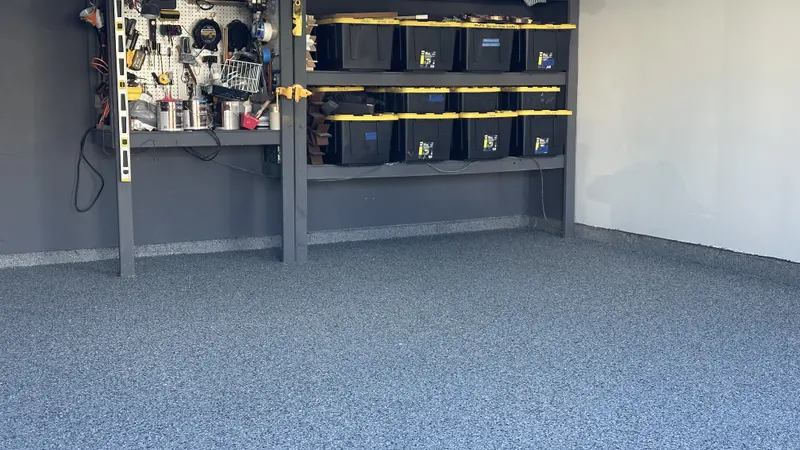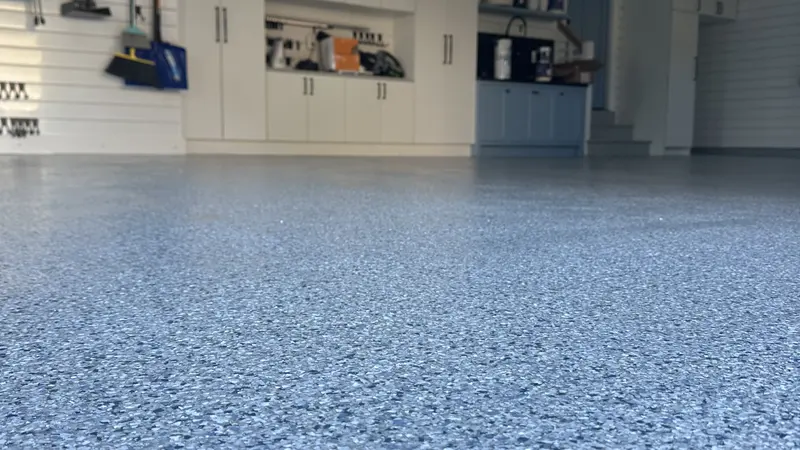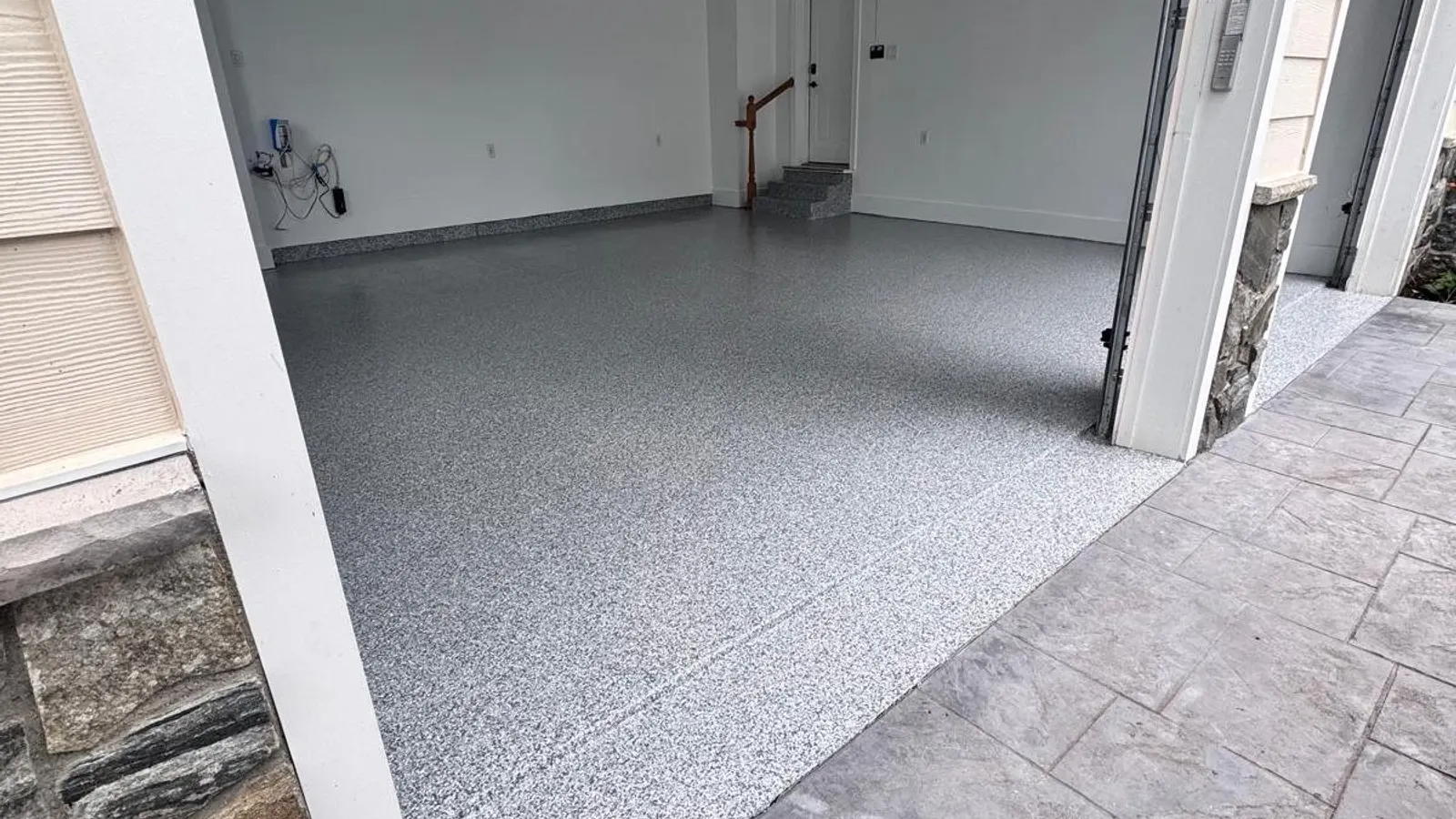
Both finishes use the same polyaspartic coating and the same one-day install. The difference is what goes in the middle: a flake floor gets vinyl chips broadcast into the base coat before the clear topcoat, and a solid color floor does not. That one step changes the texture underfoot, how much dirt the floor shows, and how forgiving it is about small imperfections in your concrete. For most Northern Virginia garages, flake is the better match, and this post explains when solid color is still the right call.
What actually changes when you add flake?
Flake is a vinyl chip, roughly the size of a fingernail clipping, in a blend of colors. We broadcast it into the wet base coat until the floor is fully covered, then scrape back the high points and seal everything under a clear polyaspartic topcoat. The chips sit inside the coating, not on top of it, so nothing peels off when you drag a toolbox across the floor.
The result is a floor with a slight orange-peel texture you can feel through socks. That texture is doing three jobs at once. It breaks up reflected light so dust, tire marks and footprints do not read as obvious. It gives your shoes something to grip when the floor is wet. And it creates a visually busy surface that hides the small ripples and trowel marks almost every poured slab has.
A solid color coating does none of that. It is a smooth, uniform, saturated surface. Pour a bag of potting soil on it and you will see every grain. Walk in with wet boots and the floor shows the path you took. That is not a defect, it is just what a smooth monochrome surface does.
Which one hides Northern Virginia dirt better?
Flake, and it is not close. Our dirt here is specific: red-orange clay that tracks in on tires and shoes, pollen in April and May, and from roughly December through March, a white film of road salt and brine from the VDOT trucks that run Route 7, the Fairfax County Parkway and every neighborhood collector road.
A flake blend with warm tones in it, like Creekbed, absorbs clay dust visually. You notice the floor is dirty when you look for it, not every time you open the garage door. Gravel does the same thing with gray grit and salt residue. On a solid charcoal or solid tan floor, that same week of dirt looks like neglect.
This matters more than people expect, because the honest answer to "how often will I need to clean it" depends heavily on how visible the dirt is. Both finishes clean the same way, with a dust mop and occasionally a mop with warm water, as covered in our guide to cleaning and maintaining a polyaspartic floor. Flake just buys you more time between cleanings before you feel the urge.
Is one safer to walk on when it is wet?
Flake has more grip. The chip texture gives the sole of your shoe edges to catch, which is the whole reason you see flake floors in commercial kitchens and locker rooms.
In a Northern Virginia garage this comes up more often than you would think. A car that has been driven through February slush drips for twenty minutes after you park it. Summer here is humid enough that a cool slab will sometimes sweat on a muggy July morning. If you have kids running in from the driveway, someone in the house with unsteady footing, or you carry heavy things from the car to the kitchen door, the extra traction is worth having.
Solid color coatings can be made less slick by adding a texture additive into the clear topcoat. It works, and it is the standard approach when someone wants a smooth look in a garage. It just does not give you the same grip as a full flake broadcast, and it changes the sheen slightly.
What about the condition of my concrete?
This is the part people do not anticipate. A coating follows the shape of the slab underneath it. We grind the concrete, fill cracks and patch pitting before anything else goes down, and a well-prepped repair disappears under flake almost entirely. Under a solid color, a patched spot can read as a subtle shadow in the right light, because there is no visual texture to break it up.
Older slabs in places like Vienna, McLean and parts of Arlington have often had thirty or forty years of freeze-thaw, salt and settlement. They can absolutely be coated, and we do it constantly, but they carry more history than a slab poured five years ago in Brambleton. If your floor has spalling, old oil stains that bled deep, or a patchwork of past repairs, flake gives you a better-looking result for the same work. We go deeper on that in our post on coating a garage floor with cracks and pitting.
Newer construction cuts both ways. A slab poured in the last few years is usually flat and clean, which makes solid color a realistic option. It may also still be releasing moisture, which is a separate issue worth understanding before you pick anything. Our article on moisture in a concrete slab explains what to watch for.
How does each one fit the way you use the garage?
Start with what the space actually is, not what it looks like in a photo.
- Two cars, bikes, trash cans, lawn equipment. The standard Northern Virginia garage. Flake. It handles grit, hides daily mess and takes the abuse of things being dragged around.
- Home gym or half-gym. Flake. Dropped plates, chalk dust and sweat all disappear into a chip blend, and the texture helps during lateral movement. We covered the floor side of this in building a home gym in the garage.
- Workshop with a bench and tools. Flake, usually. Sawdust and metal shavings show less, and you are less likely to notice the scuffs that come with moving machinery.
- A display garage for a car you care about. This is where solid color and metallic finishes earn their place. A deep solid gray or black under good lighting makes the car the subject and the floor the backdrop. Owners doing this usually keep the space clean and climate-controlled anyway.
- A finished basement, playroom or finished bonus space. Either one works. Solid color reads more like a finished interior floor; flake reads more like a durable utility floor. The lighting in the room matters a lot here.
- Townhome single-bay garage. Usually flake. These spaces do double duty as storage, mudroom and parking, and a lighter flake blend bounces more light around a narrow bay.
Do they cost the same and last the same?
Both are polyaspartic, so the durability story is identical: UV stable so it will not yellow where afternoon sun hits through the open door, resistant to hot tire pickup, road salt, oil and impact, and good for 15 to 20 years or more with a fresh clear topcoat every 5 to 7 years. Both install in a single day. You can walk on the floor that same day, and you park on it after 24 hours.
Pricing in Northern Virginia runs $1,500 to $2,000 for a one-car garage around 200 square feet, and $3,500 to $4,000 for a two-car garage in the 400 to 500 square foot range. The variables are the condition of your concrete and the finish you choose, which is exactly why we bring a firm price to the estimate rather than quoting over the phone. There is more detail in our cost guide for Northern Virginia.
How do I decide without guessing?
Look at chips and colors in your own garage, under your own lighting. A sample that looks perfect on a screen or under showroom fluorescents can look completely different against your walls with the door open on an October afternoon. You can preview the blends on our flake color page, but the real decision happens when the samples are on your floor next to your car.
One more practical note for this time of year: polyaspartic cures down to 30°F, which means fall and winter installs work fine here. Epoxy generally needs 50°F or warmer. If you have been putting this off since summer, the calendar is not the obstacle you think it is.
See the samples in your own garage
We will bring physical flake and solid color samples to your home, look at your concrete, and give you a firm price in about 20 minutes. Call or text 703-936-9006 or request an estimate and we will come out anywhere in Loudoun, Fairfax, Prince William or Arlington counties. No pressure. No obligation.
Quick answers
Yes, border and inset designs are possible with polyaspartic, though they add layout steps to the install. Bring it up at the estimate so we can look at your slab dimensions and talk through what will actually look right in your bay.
No. The flake is sealed under a clear topcoat, so the surface is smooth enough to dust mop or push-broom easily. It has texture you can feel, but it is nothing like the roughness of bare or broom-finished concrete.
A polyaspartic coating resists hot tire pickup, so the coating itself will not lift. You may still see temporary rubber transfer marks on a smooth solid color, and they are more visible than they would be on a flake blend. They come off with a mop and warm water.