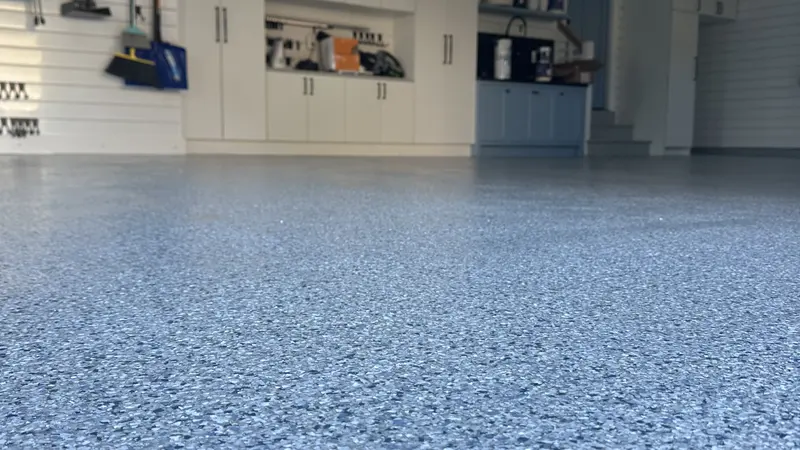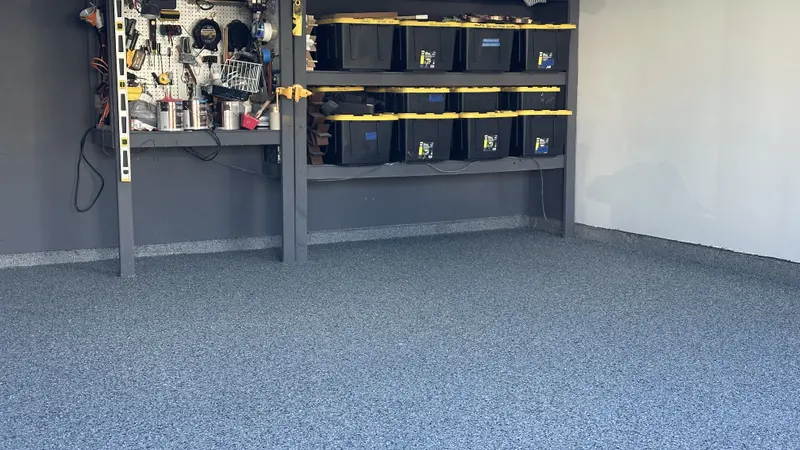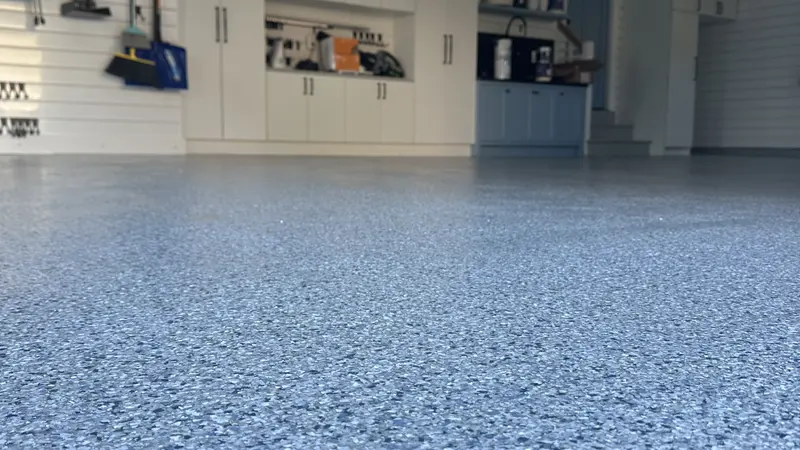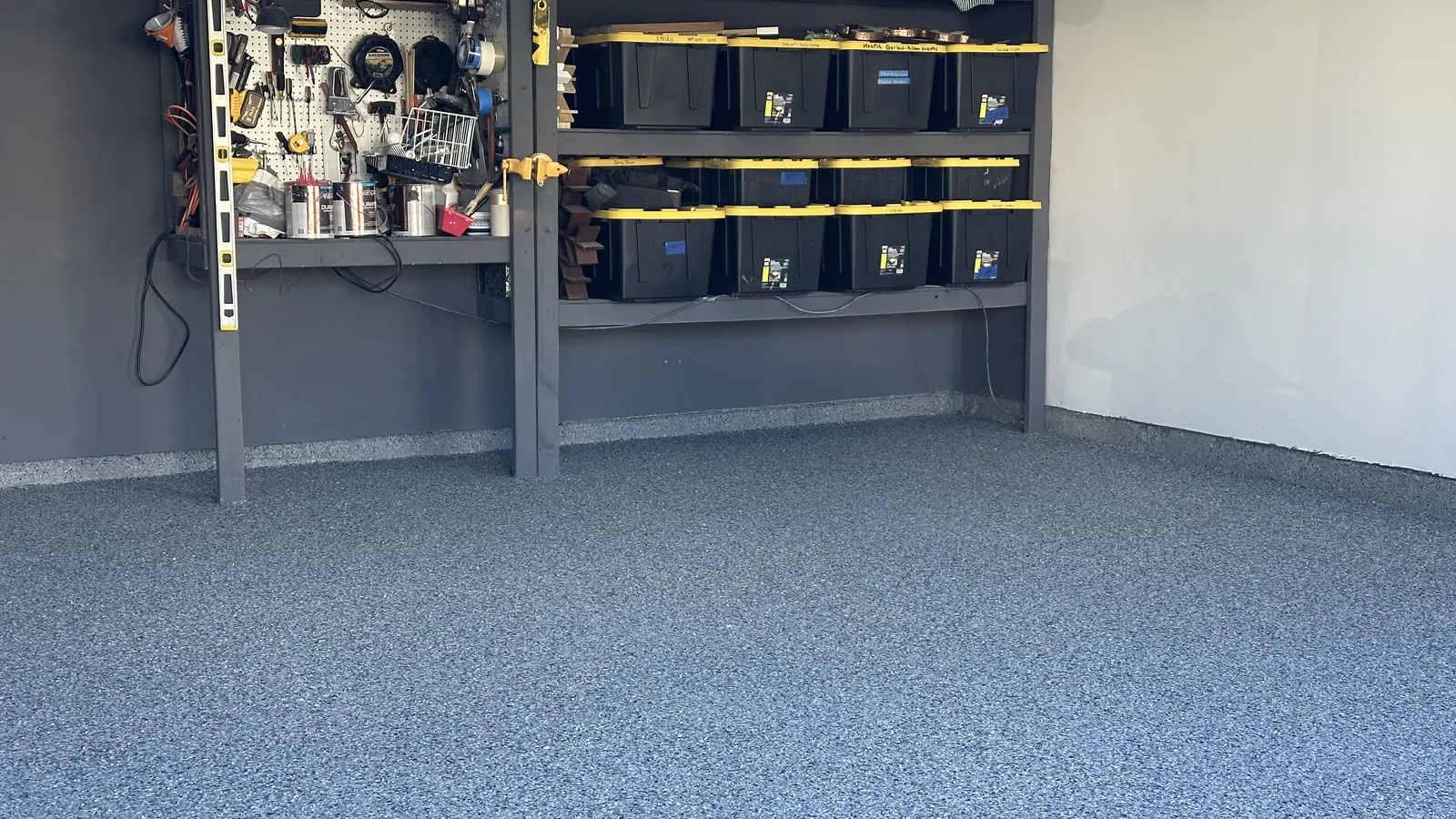
Yes, a garage slab poured in 1972 can take a coating. In most cases it takes one better than a slab poured last year, because decades-old concrete is fully cured and fully dry. The work is in the prep: diamond grinding off the old sealer and stains, filling the cracks and pitting, and getting a flat, clean, open surface before anything is rolled on. That is where the time goes on a Fairfax job, and it is the part that determines whether the floor still looks good in fifteen years.
Fairfax County has a lot of old concrete. Neighborhoods around the City of Fairfax, Oakton, Vienna and Burke were built out in waves from the 1950s through the 1980s, with Centreville and Chantilly filling in through the 1990s. If your house is from any of those eras, your garage floor has been through roughly forty winters of road salt, oil drips and freeze-thaw cycles. It looks rough. It is usually still sound.
Is my old Fairfax garage slab too far gone to coat?
The honest answer is that most of them are not. Surface damage looks dramatic and matters very little. Structural damage is rare and matters a lot.
Things we repair as a normal part of the job: hairline and moderate cracks, spalling where the top layer has flaked off, pitting from salt, old anchor holes, chips at the apron edge, and the gouges left behind when somebody chiseled up an old paint job. Those all get ground, filled and leveled before the base coat goes down. There is more detail in our post on coating a garage floor that has cracks and pitting.
Things that need attention before a coating makes sense: a slab that has broken into pieces moving independently of each other, a section that has dropped an inch or more from soil settlement underneath, or an active water intrusion problem where the slab stays visibly damp. Northern Virginia's clay soil is good at holding water against a foundation, and in a few older homes with poor grading or a failed downspout, you see it at the slab. That is a drainage problem, not a flooring problem, and a coating will not solve it. We will tell you that at the estimate rather than take the job.
What does forty years of road salt actually do to concrete?
Virginia doesn't salt as aggressively as states farther north, but VDOT brines I-66, Route 50, Braddock Road and the Fairfax County Parkway before every storm, and your tires carry that home. The brine melts off in a warm garage and pools under the car.
Salt does not dissolve concrete. What it does is drive more water into the pores and then make that water freeze and thaw at different temperatures than it otherwise would, so the surface layer gets pushed apart from the inside. Over decades the result is pitting: thousands of small shallow craters, usually worst in the two tire tracks and along the front edge where snow melts off the bumper. Combine that with Fairfax's wild winter swings, where we can go from 15 degrees to 55 degrees in forty-eight hours, and you get a lot of cycles per season.
Pitting is cosmetic until it isn't. A pitted floor traps dirt and moisture, cannot be swept clean, and keeps getting slightly worse each winter. A coating stops the cycle because water never reaches the concrete again. That is the practical argument for doing this on an older slab rather than a new one.
What has to come off before the coating goes on?
Older garages usually have something on them already. The common ones in Fairfax:
- Gray or battleship-blue floor paint. Popular in the 70s and 80s, now peeling in sheets.
- A clear or solvent-based sealer applied at some point by a previous owner, often invisible until water beads on it.
- A DIY epoxy kit from a big-box store, typically delaminating in the tire tracks.
- Adhesive from old vinyl tile or carpet in a converted garage.
- Decades of oil soaked into the pores under where the car has parked.
All of it comes off with diamond grinding. Nothing gets coated over. Grinding does two jobs at once: it removes the old material, and it opens the concrete's pore structure so the base coat can key into it mechanically instead of just sitting on top. A coating that is only sitting on top is a coating that will peel, which we wrote about in detail in why garage floor coatings peel.
Deep oil contamination is the one thing that takes extra attention on an old slab. Oil that has wicked several millimeters into the concrete has to be drawn out or ground past before the floor will accept a coating in that spot. It is a known, solvable problem, and we check for it when we look at the floor.
Does old concrete hold moisture differently than new concrete?
It holds it more predictably. A new slab in a Chantilly or Centreville build is still releasing water from the original pour for months, which is why new construction is the one case where waiting has a real benefit. A forty-year-old slab in Vienna finished curing before you bought the house.
What an old slab can have is moisture moving up through it from the ground, especially in homes built before vapor barriers under slabs became standard practice. In Fairfax that shows up as a persistently damp patch, efflorescence (the white chalky residue), or a floor that darkens after heavy rain. It is worth understanding before you spend money on a floor, and we covered the subject in what slab moisture means for a garage floor coating.
October is a good month for this work in Northern Virginia for a straightforward reason: humidity has dropped off, the slab is dry, and temperatures are moderate. Polyaspartic also cures down to 30°F, where epoxy generally needs 50°F or warmer, so a Fairfax garage coated in December behaves the same as one coated in May.
What will it look like when an old floor is done?
Flat, uniform and consistent in color. The repairs disappear under the base coat and flake. That is the main reason flake blends are the most popular choice on older slabs: the broadcast flake adds visual texture that breaks up the eye, so a floor that has been patched in a dozen places reads as one surface. Solid colors show every variation in the substrate underneath. Flake does not.
Our three featured blends are Creekbed, Tidal Wave and Gravel, and you can see them on the flake color page or in our breakdown of how to choose between Creekbed, Tidal Wave and Gravel. We bring physical samples to the estimate so you can set them on your own floor in your own light, which matters more than anything on a screen.
The finish is polyaspartic, the same class of industrial coating used in factories, rail cars and stadium concourses. It is zero VOC, UV stable so it will not yellow in the sun coming through an open garage door, and it resists hot tire pickup, oil, chemicals and road salt. It lasts 15 to 20 years or more, with a fresh clear topcoat every 5 to 7 years keeping it looking new, and it is backed by a lifetime warranty.
How long does it take, and what does it cost in Fairfax?
One day. We grind, repair the cracks and pitting, lay the base coat, broadcast the flake and seal it with a clear topcoat, all in a single visit. You can walk on it that same day. Wait 24 hours before you park a vehicle on it. The garage needs to be completely empty before we start, which for most Fairfax homeowners is the hardest part of the whole project.
| Garage size | Typical range |
|---|---|
| One-car (about 200 sq ft) | $1,500 to $2,000 |
| Two-car (about 400 to 500 sq ft) | $3,500 to $4,000 |
Final price depends on the condition of the concrete and the finish you choose, which is exactly why the estimate happens at your house and not over the phone. More on the variables in our Northern Virginia cost guide, and the full day-of sequence in our installation walkthrough.
Get a firm price on your Fairfax garage
We have been coating floors in Northern Virginia since 2014, and we are based in Leesburg, not a franchise office somewhere else. The estimate takes about 20 minutes, includes physical color samples and ends with a firm number. Call or text 703-936-9006, see our Fairfax service page, or send us a note through the contact form. No pressure. No obligation.
Quick answers
No. Crack and pitting repair is part of the installation, and it happens after we grind the floor so the filler bonds to clean concrete rather than to old sealer or paint. Patching it yourself first usually means we have to grind the patch back out.
No, diamond grinding takes it off. You do not need to scrape, strip or chemically treat the floor before we arrive, though the garage does need to be completely cleared out on install day.
The apron is a separate concrete pour with different exposure, and whether it makes sense to include it depends on its condition and how it meets the garage slab. We will look at it during the free in-home estimate and give you a straight answer with the price.