Yes, and in Northern Virginia that is the usual starting point. Hairline cracks, chipped corners, popped-out divots along the garage door line and a surface that feels like coarse sandpaper are all normal conditions for a slab that has spent a decade taking on winter salt and summer humidity. Repairing cracks and pitting happens on install day, before any coating goes down. The honest exception is a slab that is still actively moving or breaking apart, and that is a different conversation we will have with you in person.
What kinds of cracks can be repaired before coating?
Most of what homeowners show us falls into a short list, and nearly all of it is fixable.
- Shrinkage cracks. Thin, wandering lines that appeared in the first year or two as the concrete cured and gave up water. They are cosmetic and stable.
- Control joint chipping. The tooled or saw-cut lines in your slab are supposed to crack. Over time the edges spall and the joint gets ragged.
- Surface pitting and spalling. Small craters where the top layer of paste has flaked away, usually worst in the tire tracks and the first few feet inside the door.
- Divots and chips. Where something heavy got dropped, or a snow shovel caught an edge.
- Stable settlement cracks. A wider crack that opened once, years ago, and has not changed since.
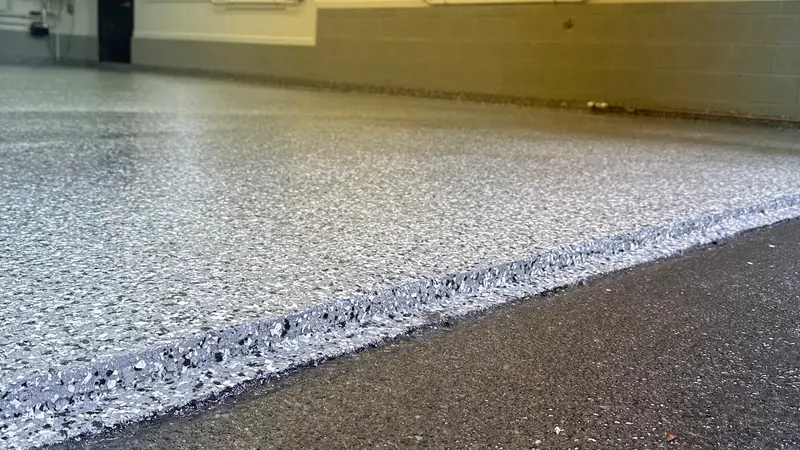
All of these get the same general treatment. The crack is cleaned and opened up so the repair material has something to grab, filled with a structural patching compound, then ground flush with the rest of the slab during grinding. Pitted areas get filled and leveled the same way. By the time the base coat goes on, you are coating one continuous surface rather than a patchwork.
What will a coating not fix?
A coating is a wear surface. It is tough, but it is a few dozen thousandths of an inch thick, and it cannot hold together concrete that is coming apart underneath it. We will tell you straight if we see any of the following:
A slab with a vertical offset. If one side of a crack sits noticeably higher than the other, the ground under the slab has moved. Northern Virginia clay soil shrinks in a dry August and swells again when it rains, and a garage slab poured over poorly compacted fill can follow it. We can grind a small lip flat. A significant step means the slab is still settling, and anything we put on top will eventually crack in the same line.
Widespread deep deterioration. A floor where the top half inch is crumbling across most of its area is not a patching job. There is a point where replacement is the right answer, and we would rather say so than take the work.
Active water coming up through the slab. Standing dampness, a persistent dark patch, or efflorescence that keeps returning after you sweep it off all point to moisture moving up through the concrete. That is worth understanding before any coating goes down, for the same reason that coatings peel when the prep or the substrate is wrong.
None of these are common. Most garages in Ashburn, Vienna, Burke and Centreville need patching and a good grind, nothing more.
Will the crack show through the finished floor?
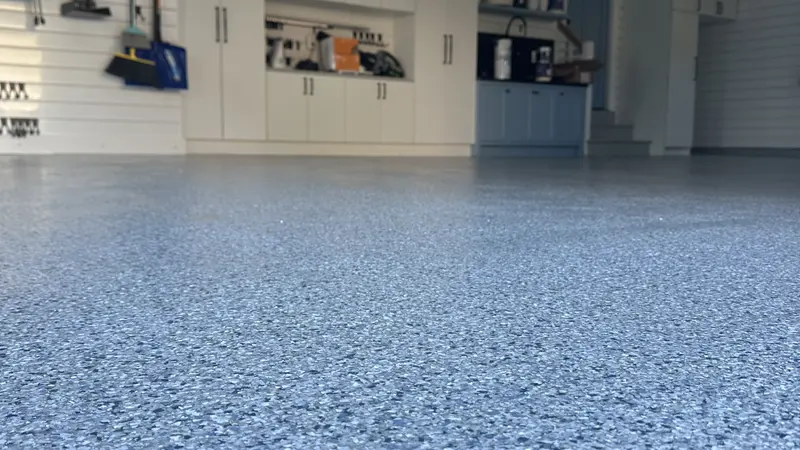
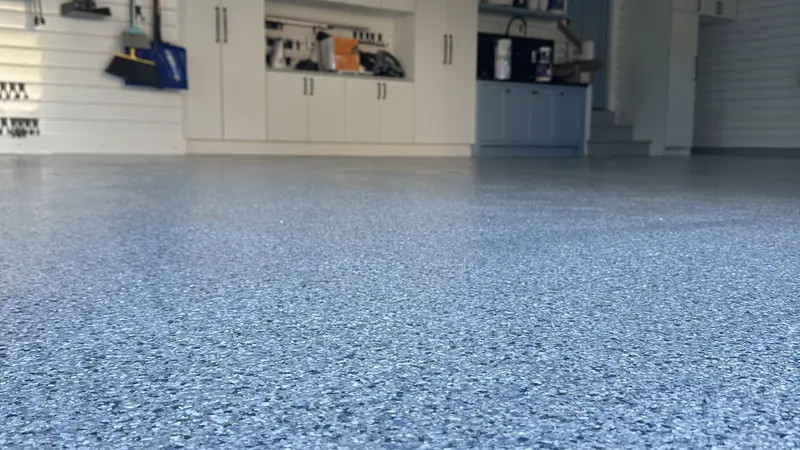
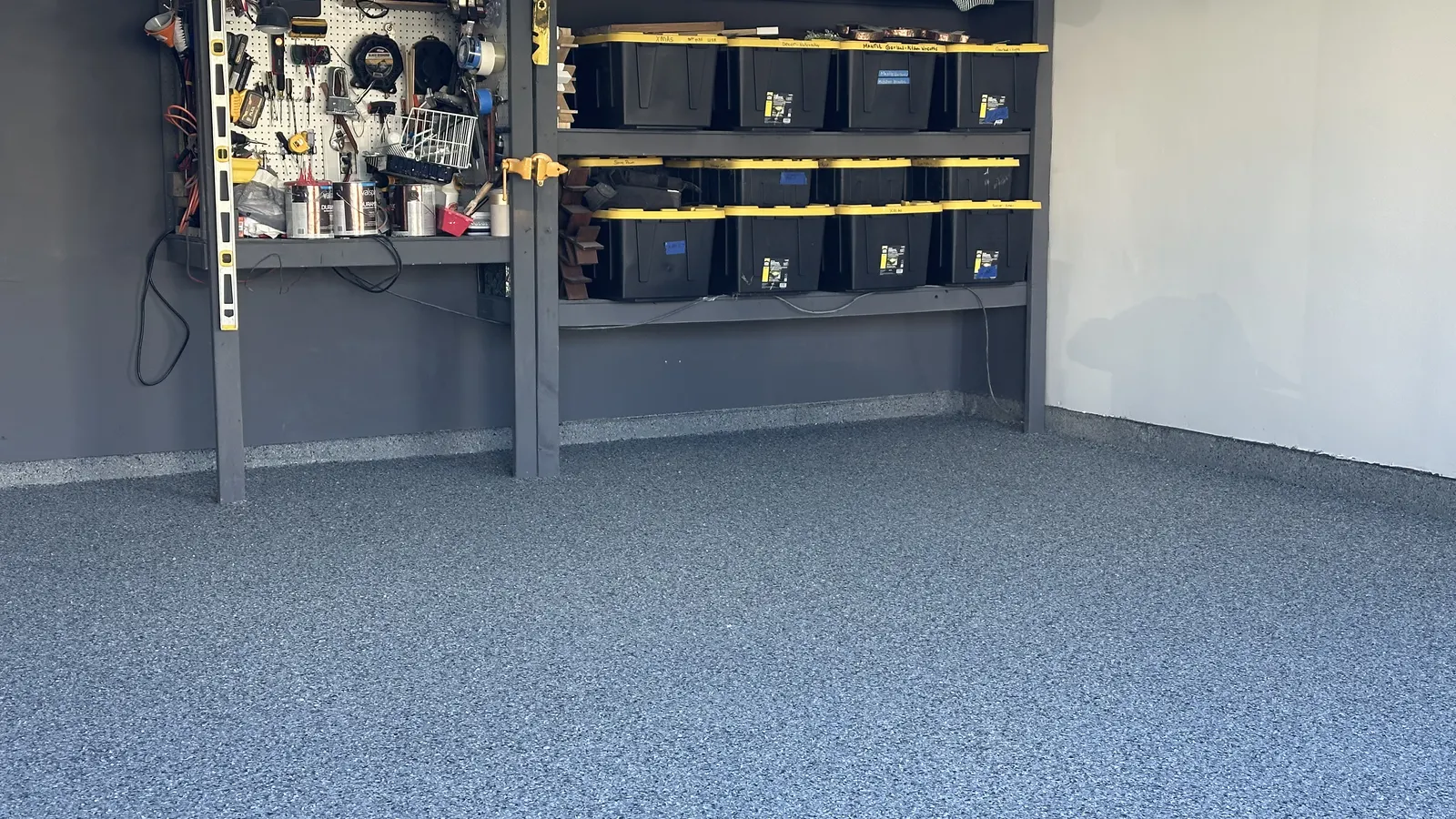
On a stable crack that has been properly chased out and filled, no. The repair is ground flat, the base coat goes over it, and the flake broadcast covers the area edge to edge. Flake is genuinely good at this. The color variation in a blend like Creekbed or Gravel breaks up your eye's ability to track a straight line across the floor, which is one practical reason flake blends are more popular than solid colors. You can see how the blends differ on our flake color page.
Where we will not promise invisibility is a crack that is still moving. If the two sides of a slab continue to shift seasonally, that movement has to go somewhere, and over time it can reflect through any rigid surface above it. We would rather set that expectation at the estimate than have you discover it in year three.
Why are Northern Virginia garage floors so pitted?
Blame the commute. Every winter, VDOT and county crews put salt and brine on Route 7, the Fairfax County Parkway, Route 28 and every subdivision street that connects to them. Your tires carry that slush into the garage, where it melts into a puddle and sits on warm concrete. Chloride soaks into the pores of the slab, and when the temperature swings back below freezing overnight, the saturated top layer expands and pops the surface paste off in flakes. Do that a hundred times over a dozen winters and you get the pitted gray texture most people assume is just what old concrete looks like.
That is also why so many people start thinking about this in October. The floor is dry, the slab is still holding summer warmth, and the salt has not started yet. If you are weighing timing, we wrote more about coating in the fall in Northern Virginia. Newer slabs in Brambleton or Lansdowne usually have less pitting and more shrinkage cracking, while 1980s and 1990s garages in Leesburg and Vienna tend to show the opposite.
Does crack repair change the price?
It can. Our pricing runs $1,500 to $2,000 for a one-car garage of about 200 square feet, and $3,500 to $4,000 for a two-car garage in the 400 to 500 square foot range. Where you land in that range depends on the condition of the concrete and the finish you pick. A floor with a few hairline cracks and light pitting sits near the bottom. A floor needing extensive patching across the whole surface sits higher.
What does not happen is a surprise. We look at your actual slab, price the repair work into the number we give you, and that number is firm. If you want the fuller breakdown, see our post on what garage floor coating costs in Northern Virginia.
How does the repair fit into a one-day install?
It all happens in the same visit. We grind the slab with diamond tooling to open the concrete and strip off old sealers and stains. Cracks and pitted areas are repaired and ground flush. Then the polyaspartic base coat goes down, flake is broadcast into it while it is wet, and a clear polyaspartic topcoat seals everything in. The garage needs to be completely empty before we arrive.
You can walk on the floor the same day. Wait 24 hours before parking a vehicle on it. After that, the repaired areas are under the same coating as the rest of the floor, with the same resistance to road salt, oil, hot tire pickup and impact, and the same lifetime warranty. A fresh clear topcoat every five to seven years keeps it looking new. More detail on the sequence is in our step-by-step installation day walkthrough.
Have us look at your floor
If you are not sure whether your cracks are cosmetic or structural, that is exactly what the free 20-minute in-home estimate is for. We will look at the slab, tell you honestly what it needs, bring physical color samples and leave you with a firm price. Call or text 703-936-9006 or send us a note through our contact page. No pressure. No obligation.
Quick answers
No, and please don't. Hardware-store crack filler and patching compound sit on top of the concrete and often have to be ground back off, which adds work rather than saving it. Leave the floor as-is so we can see the actual condition of the slab at the estimate.
Control joints are intentional cuts that give the concrete a planned place to crack, and how they are handled depends on the slab. We go over the approach for your specific floor during the free in-home estimate, once we have seen the joints and how they have aged.
Call us at 703-936-9006 and we will come look at it. Our polyaspartic coating is backed by a lifetime warranty, and we walk through exactly how that works, and what a given situation would fall under, at the estimate before you commit to anything.