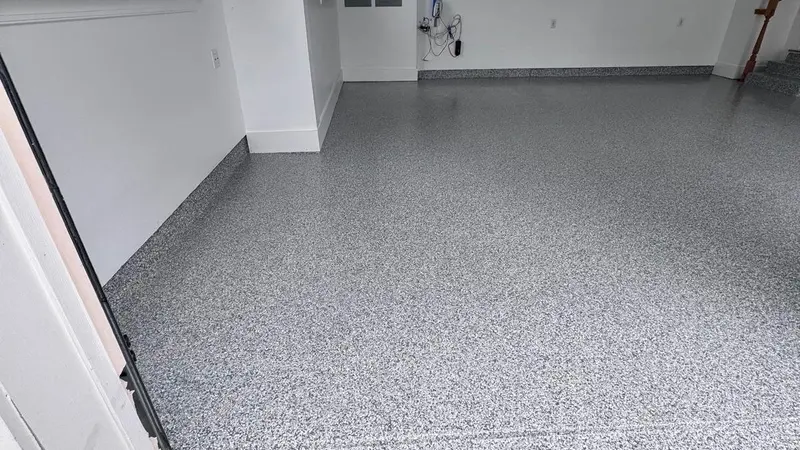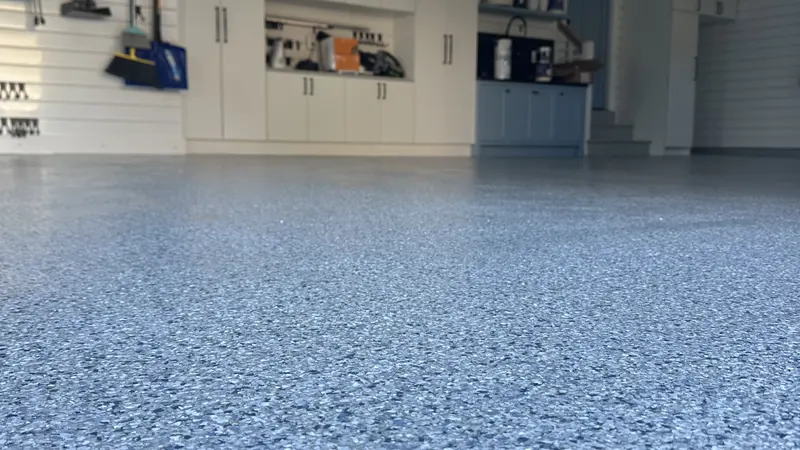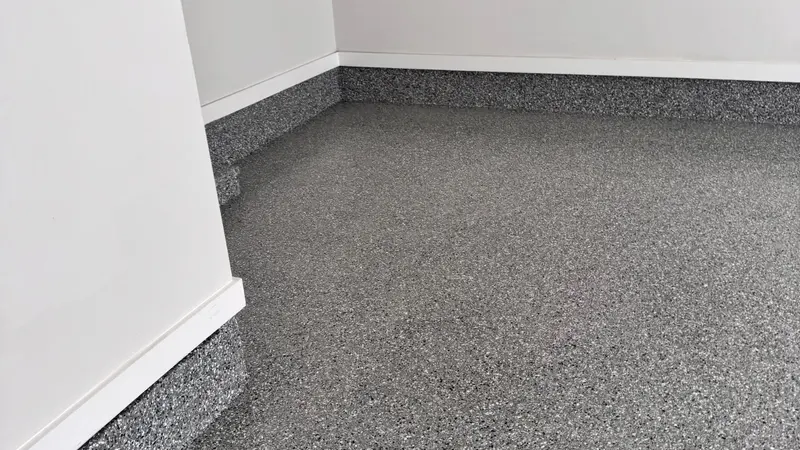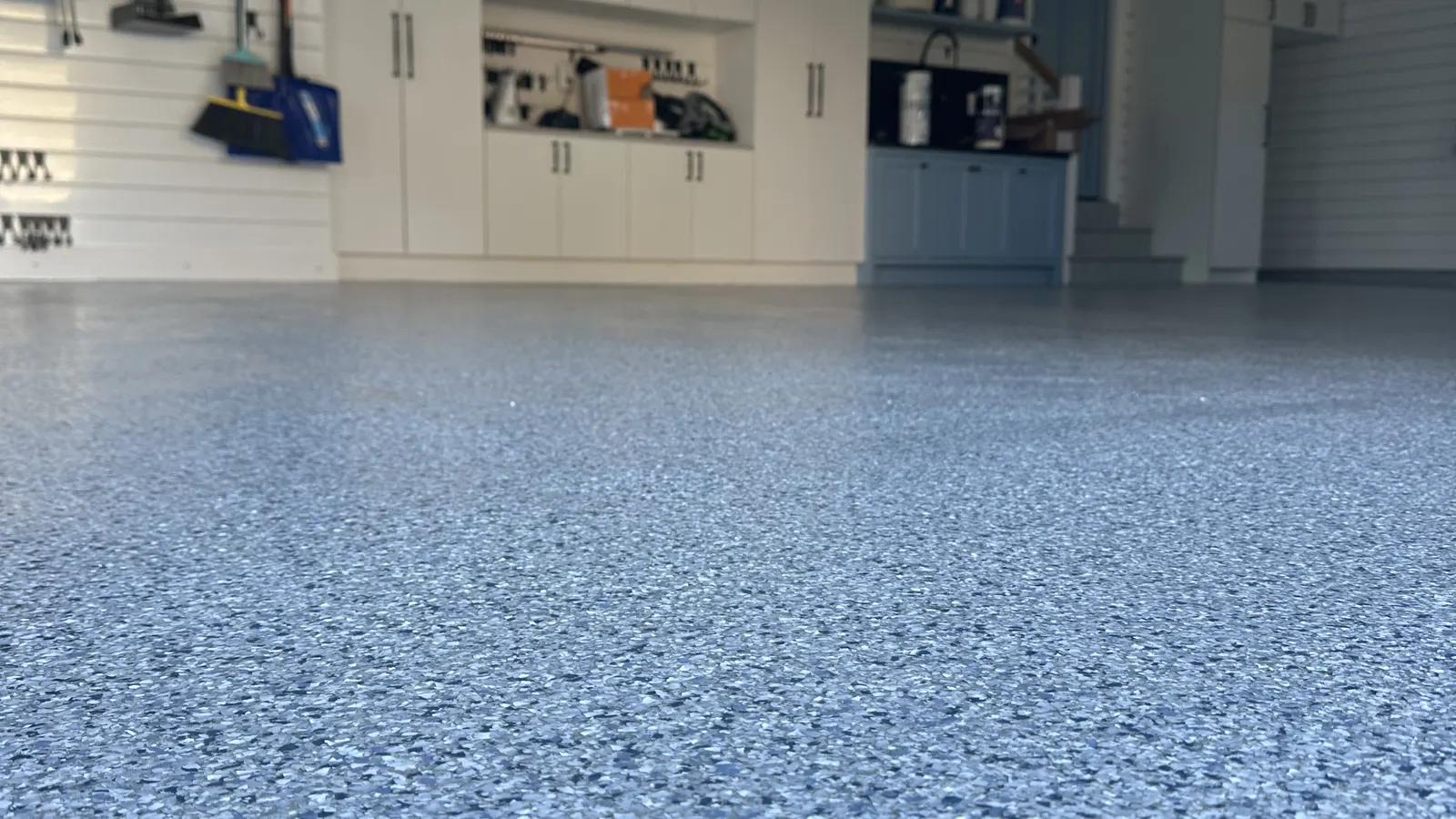
Diamond grinding is mechanical: spinning discs with industrial diamond segments shave off the top layer of the slab and leave behind a clean, uniformly rough surface. Acid etching is chemical: a diluted acid is poured on, reacts with the cement paste, and is rinsed away. Both are trying to accomplish the same thing, which is giving the coating something to grip. Only one of them does it reliably, which is why professional polyaspartic installs start with a grinder and why acid etching lives almost entirely in the instructions printed on the side of a big-box coating kit.
If you are getting quotes right now, prep is the line item that separates a floor that lasts 15 to 20 years from one that starts lifting at the garage door in two winters.
What does diamond grinding actually do to the concrete?
The top eighth of an inch of a poured slab is not the same material as the concrete underneath it. When concrete is finished, water and fine cement particles rise to the surface and form a weak, dense layer called laitance. Troweling compacts it further and closes the pores. On most garage floors, there is also a builder's cure-and-seal product on top of that, plus years of tire rubber, road salt residue, oil and whatever was spilled and mopped up.
A coating bonded to that layer is bonded to the weak stuff, not to the slab. Diamond grinding removes it. The machine takes the surface down to sound concrete and leaves a texture you can feel with your palm, somewhere between fine sandpaper and a sidewalk. That texture is what the base coat sinks into. Mechanical bond, not chemical hope.
Grinding does a few other things that matter just as much:
- It takes off old sealers, paint, mastic and failed coatings so you are starting on bare concrete.
- It knocks down trowel ridges and high spots so the finished floor reads flat.
- It opens up the real condition of the slab. Hairline cracks, spalled areas and pinholes that were hidden under a sealer show themselves clearly, which is exactly when you want to find them.
That last point is underrated. You cannot properly repair cracks and pitting in a garage floor you have not exposed. Grinding first, then repairing, then coating is the sequence that holds.
What does acid etching do, and where does it fall short?
Etching uses an acid, usually muriatic or a phosphoric blend, to dissolve some of the cement paste at the surface and leave behind a light texture. On clean, bare, porous concrete that has never been sealed, it does produce a profile. That is the narrow case where it works, and it is why the method exists.
The problems start as soon as the floor is a real garage floor.
Acid does not remove sealers or coatings. It barely touches them. If a builder applied a cure-and-seal, the acid beads up on the sealed areas and bites hard into the spots where the sealer has worn through. You end up with a floor that is etched in traffic lanes and untouched along the walls, which means the coating bonds in some places and not others. The failure is invisible for a while, then shows up as a peeling edge.
Acid does not remove oil either. Oil has soaked into the pores, and the acid runs right over it.
Then there is what the acid leaves behind. The reaction produces salts and residue that have to be fully neutralized and rinsed, usually more than once. Anything left in the pores sits between your concrete and your coating. And the rinse water has to go somewhere, which in a Northern Virginia neighborhood means it goes down the driveway toward a storm drain.
Finally, the slab has to dry completely before anything is applied. You just soaked it. In November in Leesburg or Centreville, a slab that got flooded with water can hold that moisture for days, and moisture in a concrete slab is already one of the more common reasons coatings let go here.
How do the two compare, point by point?
| Prep task | Diamond grinding | Acid etching |
|---|---|---|
| Removes weak surface layer | Yes | Partially, where acid can reach |
| Removes old sealer or coating | Yes | No |
| Removes oil contamination | Yes, with the affected concrete | No |
| Consistent profile across the floor | Yes | Uneven |
| Flattens trowel ridges | Yes | No |
| Adds water to the slab | No | Yes, a lot |
| Reveals cracks and pits for repair | Yes | Rarely |
Why does prep matter even more on Northern Virginia slabs?
Two things work against garage floors here. The first is winter chemistry. Virginia and the counties run brine and rock salt on the roads from December through February, and your tires carry it straight into the garage, where it melts into a puddle and sits. Chloride-laden water works into open pores and freeze-thaw cycles pry at the surface. A slab that has taken ten or fifteen winters of that has a surface layer that is chemically loaded and physically weak. Etching it does not fix that. Grinding removes it.
The second is new construction. In Brambleton, Broadlands, Lansdowne, Brambleton's newer sections and the Gainesville and Bristow corridor, the garage slabs are young and often have a cure-and-seal film on them. Homeowners look at that floor and see clean, smooth, nearly new concrete and reasonably assume it needs less prep. It needs the same grinding, because that film is exactly what a coating cannot stick to. We cover that split in more detail in our post on older slabs versus newer builds.
Cold weather is also a practical argument for grinding. It is a dry process. Polyaspartic can be installed in temperatures down to 30 degrees, so a December install in Ashburn or Vienna is realistic, but only if you are not trying to dry a slab you just rinsed with a hose in a 38-degree garage.
How can you tell whether a contractor is really grinding?
Ask three direct questions and listen for specifics.
- What machine are you using, and how is the dust controlled? A real answer names a walk-behind grinder running into a vacuum. A vague answer is a bad sign.
- What happens to the cracks and pits after grinding? You want to hear that they are repaired after the grind and before the base coat, not filled beforehand and ground over.
- What do you do at the edges and in the corners? Big machines cannot reach the perimeter. Hand grinders do. Coatings fail at edges first, so this is not a detail.
If a quote mentions etching, washing or "cleaning and prepping" with no mention of mechanical grinding, you are looking at a different product than the one that lasts. That is the thread we pull on in why garage floor coatings peel.
Where does grinding fit in the install?
Grinding is the first step of a one-day polyaspartic install, not a separate visit. The floor gets ground, cracks and pitting get repaired, the base coat goes down, flake is broadcast into it, and a clear topcoat seals everything. You can walk on it the same day. Vehicles go back in after 24 hours. The full sequence, hour by hour, is in our step-by-step walkthrough of installation day.
The one thing we need from you is an empty garage. Grinding reaches wall to wall or it does not do its job.
Want to know what your slab actually needs?
The honest answer to "how much prep does my floor need" comes from looking at the concrete, not from a phone call. Book a free 20-minute in-home estimate and we will read the slab, show you physical flake samples in your own light, and give you a firm price. Call or text 703-936-9006 or use the contact form. No pressure. No obligation.
Quick answers
Professional grinders run with a vacuum attached, so the dust is pulled off the floor as it is created rather than settling on your walls and shelves. It is not a dust-free process, but it is nothing like running a rental machine with no containment, and the garage gets vacuumed before any coating goes down.
No. Shot blasting fires steel pellets at the concrete to hammer out a profile, and it is common on large commercial slabs. Diamond grinding gives better control and a flatter result on a residential garage, and it handles edges and corners far more cleanly.
We do not recommend it. Rental grinders are usually underpowered for a 400 to 500 square foot slab, often come with the wrong diamond segments for your concrete hardness, and rarely have real dust control. An uneven or glazed profile is worse than no profile, because it is harder to correct.